FEATURED WORK
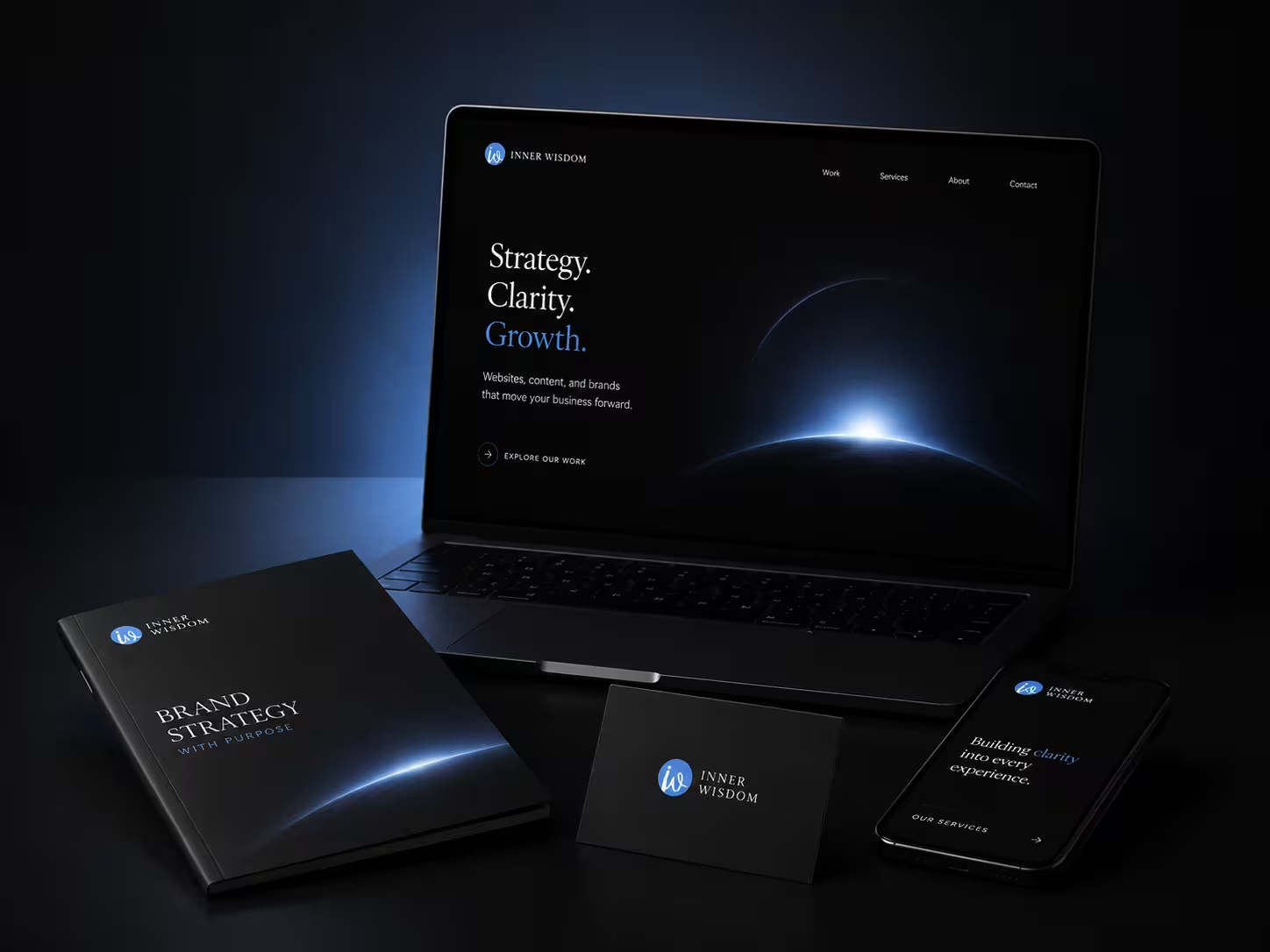
A premium digital presence designed to bring strategy, clarity, and growth into one refined experience.

Don’t Optimize for AI. Become a Brand AI Can Understand.
10 Minutes Read
August 9, 2026
Every new search shift creates a new vocabulary industry.
SEO became AEO. AEO became GEO. New dashboards appeared. New checklists promised citations in AI answers. People started discussing special files, content chunking, entity hacks, prompt tracking, and dozens of tactics before many businesses had fixed the basics of being understandable on the web.
There is real change happening. AI-generated search experiences are changing how people discover, compare, and evaluate businesses. Brand visibility is no longer only about ranking as a blue link.
But the durable response is less exotic than the hype suggests.
Do not begin by asking, “How do we optimize for AI?” Begin by asking, “Is our brand clear, useful, credible, technically accessible, and corroborated well enough that a search system can understand what we are and why we matter?”
AI search is new. The need to be understandable is not.
Google's own 2026 guidance for generative AI features is unusually direct: success in generative Search remains rooted in the same core ranking and quality systems that power Search more broadly.
That matters because it pushes back on the idea that every brand now needs a second, mysterious optimization discipline detached from SEO, content quality, and brand authority.
For Google Search specifically, there is no special AI markup required. Google says pages do not need to be artificially rewritten into “AI-friendly” chunks, and it does not require an llms.txt file for visibility in its generative search experiences. Other AI platforms may operate differently, but there is no universal file or formatting trick that makes a weak brand suddenly recommendable.
The better question is whether the web contains enough consistent evidence for a system to form a confident picture of the business.
Think in four layers: entity clarity, evidence, access, corroboration
1. Entity clarity: make it obvious what the brand is
Humans are surprisingly tolerant of ambiguity. Search systems are less forgiving.
If your homepage calls the company a “creative growth partner,” your LinkedIn page says “digital agency,” your Google Business Profile says “marketing consultant,” and every directory uses a different service description, you are forcing multiple systems to reconcile the story.
Consistency does not mean repeating identical copy everywhere. It means keeping the core facts stable: brand name, category, services, location, audience, expertise, and relationships between the organization, people, projects, and content.
Use clear organization information. Keep brand naming consistent. Build strong About and Contact pages. Connect authors to real profiles. Use structured data where appropriate, not as a magic ranking lever, but as another machine-readable expression of facts already visible on the page.
For InnerWisdom, for example, “Brand Strategy & Identity,” “Website Design & Development,” and “Content & Growth Systems” are stronger entity signals than ten rotating ways to describe the same offer for the sake of sounding clever.
2. Evidence: publish things worth citing
AI search has made generic content less defensible because generic explanations are abundant.
If an article can be produced by combining the first five search results without adding a real idea, there is little reason for a search system, or a buyer, to remember who published it.
Evidence changes that.
Publish original case studies, before-and-after decisions, benchmarks from your own work, expert commentary, process detail, datasets, useful diagrams, templates, research synthesis, and specific examples that demonstrate first-hand understanding.
Google's people-first content guidance has long emphasized original information, analysis, and substantial value beyond what other pages already provide. Generative search makes that principle more commercially important, not less.
A strong article should contain something another writer would reasonably cite.
3. Technical access: make the useful material easy to crawl and interpret
Brilliant thinking hidden behind poor technical implementation still underperforms.
Make important content crawlable. Use descriptive titles and headings. Keep key information in the HTML rather than rendering everything through inaccessible interactions. Use internal links that explain relationships between topics. Maintain clean canonicals. Avoid accidental noindex rules. Provide useful alt text for meaningful images. Keep performance healthy enough that pages are usable.
None of this is “AI SEO.” It is competent web publishing.
The reason it matters more now is that discoverability is being reused across more surfaces. A technically clean page can be found, understood, indexed, linked, and potentially used as supporting material in search experiences. A page that search engines cannot reliably access has fewer opportunities before the quality discussion even begins.
4. External corroboration: your website cannot be the only place that says you are credible
Every company website is a first-party claim. Authority becomes stronger when the wider web independently supports that claim.
Industry mentions, high-quality directories, partner pages, event participation, earned media, credible reviews, client references, podcasts, academic citations, and strong backlinks all help create context around an organization.
This is where brand building and search strategy stop being separate disciplines.
A brand with a clear point of view earns mentions. A useful tool earns links. A distinctive case study gets shared. A credible founder gets invited into conversations. Those signals may begin as marketing outcomes, but they also make the organization easier to verify.
A composite case: publishing more did not make the company more knowable
Imagine a B2B consultancy publishing four articles a month. The blog is technically active. The titles target sensible keywords. Yet almost every piece is a broad educational summary: what is digital transformation, why strategy matters, five trends to watch.
The content is not wrong. It is interchangeable.
The company's real expertise lives elsewhere: in workshop methods, difficult transformation decisions, lessons from failed implementations, internal benchmarks, and senior consultants who can explain why common advice breaks in specific contexts.
The AI-search strategy should not be to publish eight generic articles a month or rewrite paragraphs into smaller blocks. It should be to move proprietary expertise from private conversations into public, crawlable evidence.
One detailed framework supported by real examples can create more authority than twenty summaries that say nothing uniquely attributable to the firm.
What about GEO, AEO, llms.txt, and AI visibility tools?
Use new terminology carefully.
There is value in measuring how a brand appears across AI products. Prompt monitoring can reveal perception gaps. AI referral traffic can expose new discovery paths. Search Console has also begun introducing dedicated generative AI performance reporting for a subset of sites, giving marketers more direct visibility into impressions across Google's generative experiences.
But measurement is not the same thing as manipulation.
GEO and AEO can be useful labels for a changing discovery environment. They become unhelpful when the label encourages teams to bypass fundamentals and chase speculative tactics with no durable evidence.
Treat every new tactic with three questions:
- Which platform is this claim actually about?
- Is there primary documentation or credible testing behind it?
- Does the tactic improve the experience and clarity of the website even if the algorithm changes?
If the answer to the last question is no, be cautious.
Brand clarity is becoming a search advantage
Traditional SEO could sometimes reward a page even when the company behind it was not especially memorable. AI-assisted discovery increases the value of coherent brand context because users increasingly ask comparative and recommendation-style questions.
“Who are the best partners for X?” is not the same query as “X services.”
Recommendation requires a richer understanding: who the company is for, where it operates, what it is known for, what evidence supports the claim, how others talk about it, and whether the sources are consistent.
This is why brand strategy, website architecture, structured information, public expertise, PR, content, and search are converging.
The company that is easiest to understand is not guaranteed to win. But the company that is difficult to understand is making every discovery system work harder.
A practical AI-search readiness audit
Before buying another AI visibility platform, check the basics.
Brand facts
- Is the brand name written consistently across major properties?
- Are services named clearly?
- Are location and market scope accurate?
- Are key people connected to the organization?
Content evidence
- Do you publish original analysis, cases, or frameworks?
- Can important claims be verified?
- Does content show first-hand expertise rather than summarize common knowledge?
- Are authors identifiable?
Technical clarity
- Can search engines crawl the content?
- Are canonical URLs clean?
- Are headings, internal links, titles, and structured data sensible?
- Are important pages fast and accessible?
External context
- Do credible third-party sites mention the brand?
- Are client and partner relationships visible where appropriate?
- Do reviews, press, talks, or industry contributions support the positioning?
The boring answer is probably the durable one
AI search will keep changing. Interfaces will change. Reporting will improve. New optimization tactics will appear, and some will prove useful.
The brands most likely to benefit are not the ones that rename their entire marketing strategy every quarter.
They are the ones that become easier to understand, easier to verify, and more useful to cite.
Build a clear entity. Publish original evidence. Make the website technically accessible. Earn corroboration beyond your own domain.
That is not a shortcut to AI visibility.
It is the foundation that makes visibility possible in the first place.
More insights
View all
View all